
You rest for a few days. You stretch. You feel better and return to normal life—then the familiar ache shows up again.
Recurring back pain can be frustrating precisely because it does not follow a tidy script. Improvement may last days, weeks, or months. Sometimes there is an obvious trigger. Sometimes the return seems to come from nowhere.
The short answer
Back pain often returns because it is influenced by more than one factor. Activity, physical capacity, prolonged positions, sleep, stress, previous episodes, general health, and the demands placed on your body may all matter. A recurrence does not automatically mean that your spine has moved “out of alignment,” that permanent damage is occurring, or that one hidden structural problem explains everything.
The useful question is not simply, “What is the one cause?” It is, “What pattern are we seeing, what may be contributing, and what is the most appropriate next step for this person?”
Why back pain can return
Low back pain is extremely common and can affect movement, work, sleep, family life, and confidence. Many cases are described as non-specific, meaning that the pain cannot be traced to one single injured structure with certainty. That does not make the symptoms imaginary. It means the experience can involve several interacting factors.
Your workload may have changed faster than your capacity
A sudden increase in lifting, exercise, travel, household work, or time spent on your feet can ask more of the body than it is currently prepared to tolerate. The same can happen after a quiet period when normal activity resumes all at once.
The answer is not necessarily complete rest. It may be a more gradual return to activity, with the amount and intensity adjusted according to how you respond.
One position has taken over too much of the day
Sitting is not automatically harmful, and neither is standing. Trouble often develops when one position or task occupies hours without enough variation.
Long commutes around Biñan and SLEX, desk work, driving, childcare, and repetitive lifting can all create sustained or repeated demands. Even an excellent-looking posture can become uncomfortable when held long enough.
Recovery has been poor
Sleep, stress, illness, fatigue, and workload can affect how pain is experienced and how well a person tolerates activity. This does not mean that back pain is “just stress.” It means that the body and nervous system do not operate as separate departments.
You returned to everything—or avoided everything
After a painful episode, some people return to full activity before they are ready. Others become understandably cautious and avoid movement long after the acute symptoms settle.
Either extreme can make recovery more difficult. A graded return allows you to rebuild confidence and capacity without treating every sensation as damage or trying to conquer the problem in one heroic afternoon.
The situation may need a closer look
Recurring pain should not automatically be dismissed as posture or muscle tension. A history, examination, existing medical information, and the pattern of symptoms help determine whether conservative care is reasonable or whether another evaluation is needed.
Pain returning does not always mean treatment failed
Human bodies are not machines that receive one repair and remain unchanged forever. Work demands change. Sleep changes. Exercise changes. Old health conditions and new injuries may alter the picture.
The return of symptoms does not prove that your spine has “gone out” again. It also does not mean you must repeat the same treatment indefinitely. It is a reason to review what has changed, how function is affected, and whether the previous approach still makes sense.
Five practical steps that may help
1. Keep moving within a comfortable range
Prolonged bed rest is rarely the best default for uncomplicated back pain. Short walks and ordinary movement within a tolerable range may be more useful than remaining completely still.
Movement should be adjusted to the situation. Do not force sharp pain, rapidly worsening symptoms, or a movement that clearly makes you feel worse.
2. Change positions before discomfort becomes overwhelming
Use natural moments in your day—phone calls, completed tasks, fuel stops, meals, or water breaks—as reminders to stand, walk briefly, or change position.
The goal is not perfect posture. It is avoiding one posture becoming your entire day.
3. Return to activity gradually
If lifting, exercise, or a busy workday appears to trigger symptoms, reduce the dose rather than abandoning the activity forever. Fewer repetitions, lighter loads, shorter sessions, or additional recovery time can provide a starting point.
4. Notice the pattern
Write down what seems to improve or aggravate the problem. Note whether symptoms stay in the back or travel into the leg, whether sleep is affected, and whether strength, sensation, or normal movement has changed.
Patterns are often more useful during an assessment than a single pain score.
5. Measure function, not only pain
Pain matters, but it is not the only sign of progress. Consider whether you can sit, walk, sleep, work, drive, exercise, or care for your family more comfortably than before.
Meaningful improvement should connect to the life you want to resume.
When an assessment makes sense
Consider an assessment when back pain:
- keeps returning or lasts longer than expected;
- limits work, sleep, exercise, driving, or ordinary activities;
- begins traveling into the buttock or leg;
- is accompanied by numbness, tingling, or a sense of weakness;
- follows an injury; or
- concerns you even if it does not fit neatly into a checklist.
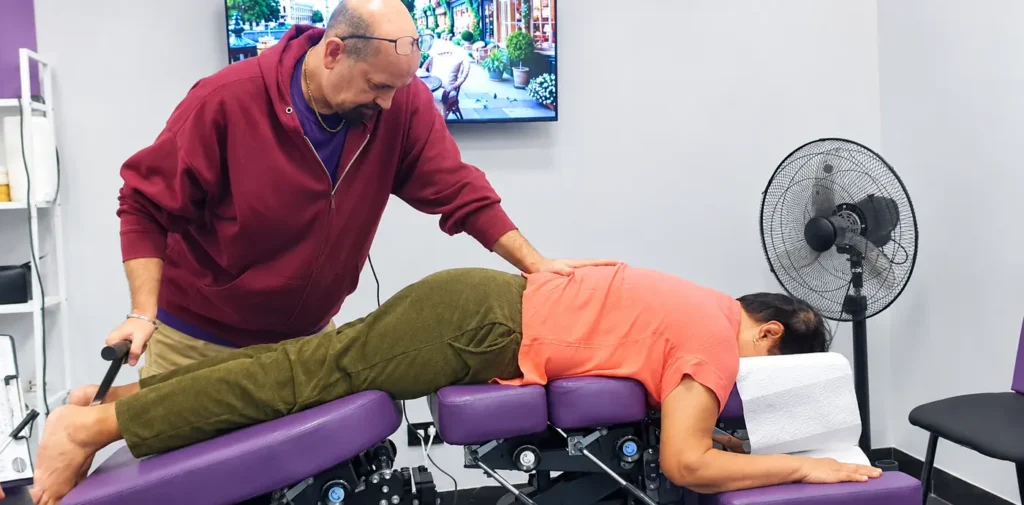
At The Chiropractor by SLEX, we begin by listening. We discuss when the pain started, what affects it, how previous episodes behaved, what care you have already tried, and what you want to do more comfortably.
The examination may include relevant movement, joint function, strength, sensation, reflexes, orthopedic tests, or assessment of nearby areas when appropriate. Imaging is not automatic. Existing records or additional evaluation may be recommended when they could meaningfully change the next step.
Where chiropractic care may fit
Spinal manipulation is one of several non-drug approaches that may be considered for some people with acute or chronic low back pain. Research suggests that it may provide modest improvements in pain and function for some patients. It is not a cure for every cause of back pain, and it should not be presented as the only useful option.
When chiropractic care appears appropriate, recommendations may include manual care, movement or activity guidance, and practical changes based on the assessment. The frequency and duration should not be predetermined for everyone. Your response, function, preferences, and goals should be reviewed as care continues.
If the findings suggest that another provider, imaging, or additional medical evaluation is the better next step, we should say so.
When to seek prompt medical care
Most back pain is not caused by a dangerous condition, but some symptoms should not wait for a routine appointment. Seek prompt medical evaluation if back pain is accompanied by:
- new loss of bladder or bowel control;
- numbness around the groin or saddle area;
- new or worsening weakness in one or both legs;
- severe pain after significant trauma;
- fever, unexplained weight loss, or feeling seriously unwell;
- a history that raises concern for infection, fracture, or cancer; or
- severe or rapidly worsening symptoms that feel unlike your usual episodes.
When in doubt, it is reasonable to seek medical advice.
The takeaway
Recurring back pain is not always evidence of one hidden defect that needs to be repeatedly “put back.” It often deserves a broader look at activity, physical demands, recovery, health history, symptoms, and function.
The goal is not to promise that discomfort will never return. The goal is to understand the current episode, identify reasonable contributors, rule out concerns that need different care, and choose a plan whose results can be reviewed.
Sources and further reading
- World Health Organization: Low back pain
- National Institute for Health and Care Excellence: Low back pain and sciatica in over 16s—assessment and management
- National Center for Complementary and Integrative Health: Spinal Manipulation—What You Need to Know
Tell Us What Your Back Has Been Doing
If back pain keeps returning or interfering with your day, an initial assessment can help us understand your history, examine relevant movement and function, and explain appropriate options.
General information only: This article is educational and is not a diagnosis or a substitute for care from a qualified health professional who has assessed you personally.