
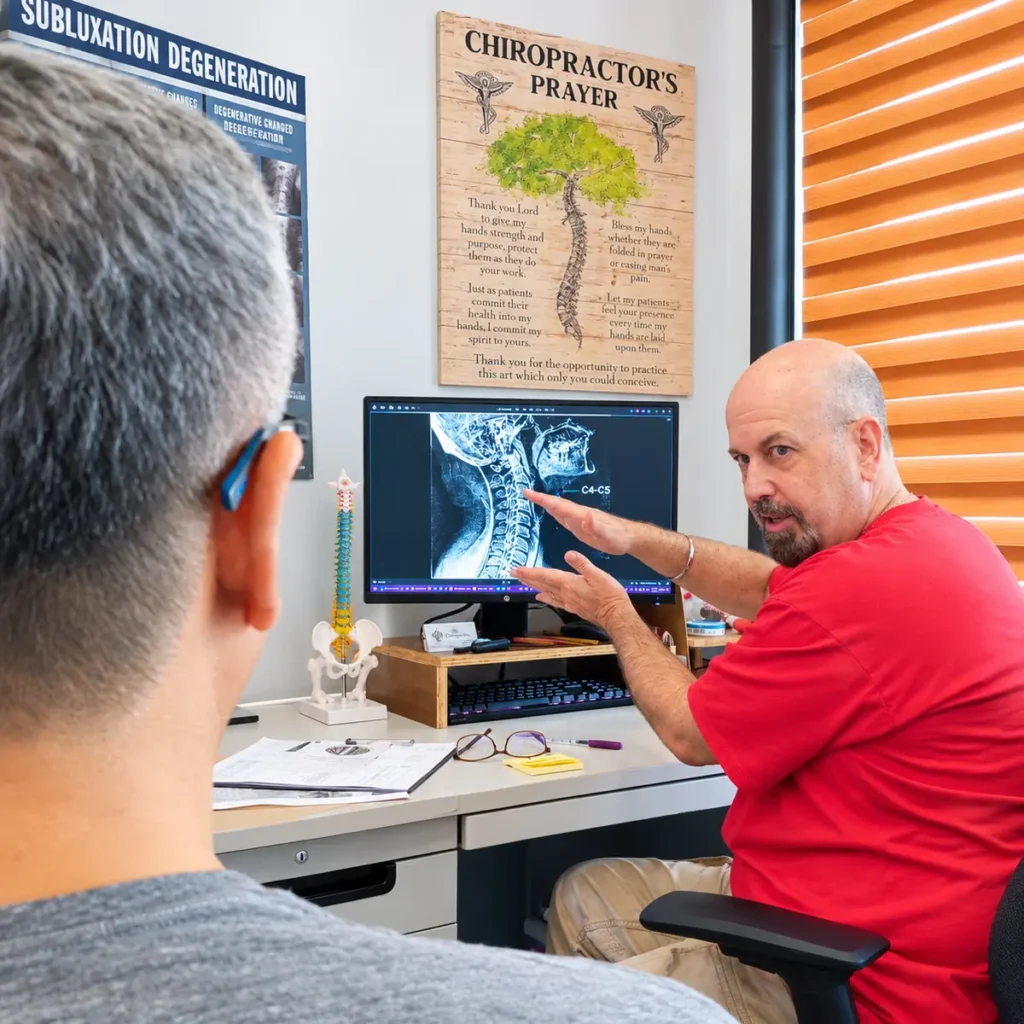
What Happens During a Chiropractic Assessment?
A good assessment should replace uncertainty with clarity. Here is how we listen, examine relevant movement and function, explain the findings, and help you decide what comes next.
Clarity Before Care
The short answer
A chiropractic assessment usually begins with a conversation about your concern and goals, followed by an examination tailored to what you are experiencing. The findings and options should be explained before you decide whether to proceed. An assessment is not a promise that treatment—or an adjustment—will happen automatically.
Walking into any new healthcare clinic can feel uncertain. You may wonder whether you will be asked to change clothes, whether X-rays are required, whether something will hurt, or whether an adjustment will happen before you have time to understand what is being recommended.
Those are reasonable questions. At The Chiropractor by SLEX, the purpose of the first visit is not to rush you through a routine. It is to understand what is bothering you, examine what is relevant, and explain the situation clearly enough that you can make an informed choice.
Before you arrive
A little preparation can make the visit easier, but you should not need to assemble a medical encyclopedia before walking through the door.
Confirm your appointment
Our team will help arrange the visit and explain how much time you should allow.
Bring useful information
If you already have relevant imaging, reports, or a current medication list, bring them. You do not need to obtain new imaging in advance unless a qualified healthcare professional advises it.
Wear comfortable clothing
Loose-fitting clothes generally make it easier to observe normal bending, turning, walking, or other relevant movement.
Think about your goals
“I want to sleep more comfortably” or “I want to turn my head when driving” can be more useful than simply saying you want the pain gone.
Step 1: We begin with your story
The conversation is not a ceremonial warm-up before the “real” examination. It is part of the assessment. Your description helps us understand what should be examined and whether anything suggests that another kind of evaluation should come first.
What are you experiencing?
We discuss where you feel the problem, when it started, whether it developed gradually or followed a particular event, and how it has changed.
What affects it?
We ask about movements, positions, work tasks, exercise, sleep, previous care, and anything that seems to improve or aggravate the symptoms.
How is it affecting your life?
A symptom matters partly because of what it prevents you from doing. Work, driving, lifting, exercise, sleep, and family activities provide useful functional context.
What would meaningful progress look like?
Your goals help us think beyond a pain score. Progress may mean moving more freely, returning to an activity, tolerating work better, or sleeping more comfortably.
Step 2: The examination follows the conversation
There is no single examination that every patient receives. The assessment should fit the concern, history, age, abilities, and clinical questions raised during the conversation.
The examination may include:
- observation of relevant posture and movement;
- range-of-motion assessment when appropriate;
- joint and functional findings;
- strength, sensation, reflexes, or other neurological screening when indicated;
- orthopedic or functional tests relevant to the concern; and
- assessment of nearby areas that may be contributing to the problem.
You should be told what is being assessed and why. If a movement is uncomfortable, say so. Good examination is not a contest to see how much discomfort a patient will quietly tolerate.
Step 3: We explain what we found
After the assessment, we bring the conversation back to plain language. We explain which findings appear relevant, what remains uncertain, and whether chiropractic care may be appropriate.
Sometimes the answer is straightforward. Sometimes existing records, imaging, medical evaluation, or another provider may be needed before a recommendation can be made. Saying “we need more information” is not a failure of the assessment. It is often the responsible answer.
Are X-rays automatic?
No. Imaging should be considered when the history and examination indicate that it may add useful information or change the next step. Existing images or reports may already be helpful. Routine imaging should not be treated as a required ticket into chiropractic care.
Step 4: You decide what happens next
If chiropractic care appears appropriate, we explain what is being recommended, the intended purpose, reasonable alternatives, and what progress could be reviewed. You have the opportunity to ask questions before deciding whether to proceed.
An adjustment or another service may sometimes be provided during the first visit when it is clinically appropriate, the recommendation has been explained, and you consent. Same-day treatment is not automatic. For some patients, the better next step is additional information or another evaluation.
Five useful questions to ask
1. What did you find?
You deserve an explanation you can understand without translating a cloud of technical language.
2. Why are you recommending this?
The recommendation should connect logically to your history, examination, and goals.
3. What are the alternatives?
Appropriate options may include chiropractic care, self-management, another provider, further testing, or a combination.
4. How will progress be reviewed?
A recommendation should leave room to evaluate your response and adjust the approach when appropriate.
5. What if I am unsure?
You can ask for clarification and take time to understand the recommendation before making a decision.
Your questions are welcome
Questions are not resistance. They are part of informed, collaborative healthcare.
Three possible outcomes after the assessment
Chiropractic care may be appropriate
We explain the proposed approach, available alternatives, and how your response can be reviewed before you decide.
More information may be needed
Existing records, clinically appropriate imaging, or another evaluation may be useful before deciding what comes next.
Another provider may be the better next step
If the findings suggest that chiropractic care is not suitable, we explain that honestly and recommend further evaluation when appropriate.
A worthwhile assessment should leave you with more understanding than you had when you arrived. You should know what was examined, what the findings may mean, and why the proposed next step makes sense.