
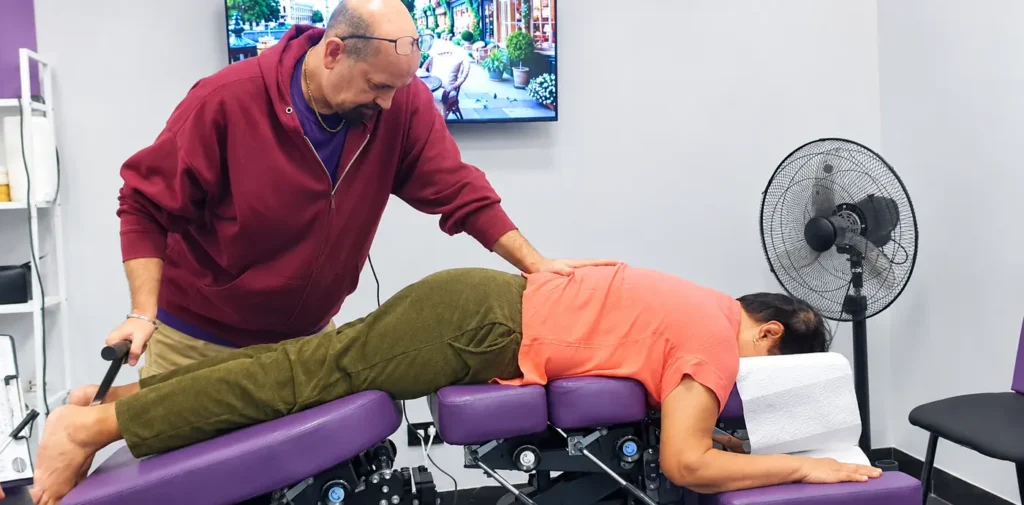
People searching for relief from back pain, leg symptoms, or a disc problem may encounter the phrase non-surgical spinal decompression. Advertisements can make it sound like a machine simply pulls a disc back into place and solves the problem. The reality is more nuanced.
Spinal decompression is not an operation. In most clinics, the term describes a form of computer-controlled mechanical traction. A patient lies on a specialized table while a harness or positioning system applies and releases a measured pulling force through part of the spine.
Some people find the experience comfortable. Others do not. More importantly, the treatment is not automatically appropriate for everyone with back pain, sciatica, or an MRI showing a disc change.
What happens during spinal decompression?
The setup varies according to the equipment and the area being treated. For lower-back treatment, the patient is normally positioned on the table with support around the pelvis and trunk. The clinician selects the direction, force, cycle, and duration based on the person and the device.
The table then applies traction gradually rather than delivering a sudden adjustment. Treatment should not feel like a contest to tolerate the greatest amount of force. If symptoms become sharper, spread farther into an arm or leg, or otherwise respond poorly, the session should be reassessed rather than pushed through.
The word decompression is easy to misunderstand. It does not mean that every painful disc is being permanently restored to a previous shape. It describes the intended mechanical effect of reducing compressive load for a period of time. What that temporary change means for an individual patient’s symptoms is a separate clinical question.
Is spinal decompression the same as a chiropractic adjustment?
No. An adjustment generally applies a controlled force to a joint, either by hand or with an instrument. Mechanical decompression applies a slower, sustained or intermittent pulling force through a larger region.
They are different procedures with different goals. A patient does not necessarily need both, and neither should be selected merely because it appears on a clinic’s service menu. The decision should follow an appropriate history and examination.
What does the evidence say?
Research on traction for low-back pain and sciatica has produced mixed results. Some individual patients report short-term improvement, but major guidelines do not recommend mechanical traction as a routine treatment for low-back pain with or without sciatica. Reviews have generally not found consistent, clinically meaningful benefits across broad patient groups.
That does not prove that no individual can ever feel better after traction. It does mean that claims such as “repairs every bulging disc,” “permanently reverses degeneration,” or “works for nearly everyone” go beyond the evidence.
A responsible conversation should therefore sound like this: spinal decompression may be considered selectively after assessment, expectations should be realistic, and continued use should depend on a meaningful response—not on a predetermined package.
When might it be considered?
A clinician might consider a cautious trial when symptoms and examination findings suggest that a patient could tolerate traction and when reasonable goals can be measured. Those goals might include sitting more comfortably, walking farther, sleeping better, or experiencing less leg irritation during ordinary activities.
The presence of a disc bulge on an MRI is not enough by itself. Disc changes are common, including among people who have no pain. The scan must be interpreted alongside the patient’s symptoms, health history, neurological findings, function, and response to movement.
If treatment is tried, progress should be reviewed. “The machine is doing something” is not an adequate outcome. The useful questions are whether symptoms and function are improving, whether any improvement lasts, and whether the plan remains appropriate.
Who may not be suitable?
Spinal decompression is not appropriate when pulling on the spine could aggravate an unstable or serious condition. A clinician may avoid it or require medical clearance when there is concern about:
- a recent fracture or significant trauma;
- severe osteoporosis or substantially weakened bone;
- spinal instability;
- infection or malignancy affecting the spine;
- rapidly worsening neurological loss;
- signs of cauda equina syndrome;
- certain recent operations or implanted devices;
- pregnancy, depending on the treatment area and positioning; or
- another condition that makes the proposed force or position unsafe.
This is not a complete self-screening list. Patients should disclose diagnoses, previous surgeries, medications, imaging, pregnancy, cancer history, recent injuries, numbness, weakness, and changes in bladder or bowel control before treatment is considered.
What should an assessment include?
At The Chiropractor by SLEX, the decision should begin with the person rather than the machine. We ask where the symptoms are felt, when they began, what makes them better or worse, whether they travel into an arm or leg, and how they affect work, sleep, driving, or exercise.
The examination may include relevant movement, strength, sensation, reflexes, joint function, orthopedic tests, and review of available medical records. Imaging is not automatic. It may be useful when the result could change management or when the history and examination raise a specific concern.
We should also explain alternatives. Depending on the situation, these might include activity guidance, exercise or rehabilitation, manual care, medical evaluation, watchful monitoring, or referral to another provider.
What should patients expect from a trial?
Before beginning, the patient should understand:
- why decompression is being considered;
- what improvement would count as meaningful;
- what sensations are expected during treatment;
- what symptoms should cause the session to stop;
- when progress will be reassessed; and
- what will happen if the expected improvement does not occur.
Temporary soreness or a change in symptoms should be reported. New weakness, numbness around the groin or saddle area, loss of bladder or bowel control, or rapidly worsening symptoms require prompt medical assessment rather than another routine session.
The honest takeaway
Non-surgical spinal decompression is a mechanical traction procedure, not a guaranteed repair for damaged discs. Evidence does not support using traction routinely for everyone with low-back pain or sciatica.
For a carefully selected patient, a monitored trial may sometimes be discussed—but only after an assessment, with realistic goals and a willingness to change course when it is not helping. Good care is defined by appropriate decisions and measurable progress, not by how impressive the equipment looks.
Considering your options?
If back or leg symptoms are affecting your day, an initial assessment can help clarify the pattern, identify concerns that need different care, and discuss reasonable options.
General information only: This article is educational and is not a diagnosis or a substitute for care from a qualified health professional who has assessed you personally.